




Success Stories


Success Stories
 Click here to read more
I studied civil engineering at the University of Manchester, in England. My first taste of consulting engineering was as a summer student in 1968, when I worked as an inspector on a highway construction project in the south of France. I had the good fortune that my mother was French, and she'd made a few phone calls to get me the job. So my first advice for you is don't knock the job your Mom gets for you – it might be the best job you ever get. Fourty years later, I still go back to look at that highway when I visit France, and I'm proud of what I did, even though I played such a small part in it.
Click here to read more
Click here to read more
A career in Consulting Engineering can take you on a thousand different career paths depending on the opportunities you find and the choices you make.
Below are contributions from consulting engineers who share their own career stories.
How Consulting Engineering is the Career Choice
Career story by André Morin, jr. eng., LEED AP
 In today’s modern life, engineering is the basis of just about everything we touch. It is easy to see the engineering behind cars, air planes, television, etc. On the other side, not many people realize that there is engineering behind the road in front of your house, the bridge that we cross, the structure in our office buildings and the systems that create the comfort in our work environment. The great majority of these items have been designed by consulting engineers. I think we can say that consulting engineering is one of the most misunderstood trades. Why? Probably because the realisations are considered to be “static” and don’t draw the attention as much as the latest BMW. Nevertheless, that very car wouldn’t have any value weren’t it for the road it travels on, the bridges it crosses or even the plant where it was built!
 |
|
|
|
 |
|
I first studied Music and Natural Science at the “Cégep de Sherbrooke”. These studies allowed me to discover different aspects of applied sciences and it convinced me that engineering would be a good trade for me. I think of myself as a problem solver. I like to find original solutions to real problems. I have good math skills, I like physical sciences such as dynamics and thermodynamics, I like teamwork and I dislike routine work.
After graduating from the Cégep, I studied mechanical engineering at Sherbrooke University with the hope of becoming an aeronautical engineer. During my studies, I had the opportunity to do internships in various companies, including consulting engineering firms. The university education I received led much more to industrial engineering than consulting engineering. I still got the chance to do a first internship with Teknika-HBA in building systems. Teknika-HBA is a firm from Quebec that works primarily in North America and has affiliated offices worldwide.
Initially I thought that, perhaps as some of you might think, that building system could be somewhat of a “dull” job since heating, ventilation, cooling and air conditioning (known as HVAC) isn’t as “dynamic” and impressive as aeronautics. However, it’s by taking part in multiple projects of various sizes that I grasped the extraordinary challenges that this industry had to offer. First off, a consulting engineer typically works on several projects simultaneously. The projects are constantly renewed and always have different problems. No routine exists in this profession. The projects are conducted in essentially the same manner, but never have the same timeframe, aren’t always for the same customer and do not necessarily cover the same features of the profession.
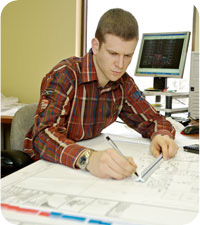 |
The job also brings me out of the office on a regular basis. I’m often out for a project start-up meeting, a field inspection or a project follow-up meeting. Compared to a researcr job, I’m not always in the same workspace, concentrated on the same project. Compared to an industrial job, I have the opportunity to work on all different phases of a project, from the start to the delivery of the final product to the customer.
Consulting engineers have their place in society as much as doctors do. Everybody needs healthcare from a doctor, but generally not every day. Companies or institutions may have needs for a support engineering service to support their operations, but they cannot afford to keep an engineer dedicated to that task in their everyday operations. So when the need arises to expand a factory or to convert a hospital wing, these companies rely on consulting engineers. They are used to answer a great array of problems that even the plant engineers can’t solve.
Consulting engineering is very difficult to teach in schools. Why? Because the knowledge span is very large to master. In my case, I worked in two related areas, namely the building mechanics and industrial mechanics. The difference between the two, in terms of consulting engineering, is primarily in the targeted clientele. The industrial mechanics, as its name implies, deals with different industrial customers. Building system applies more or less to every other customer (municipal, institutional, retail stores, etc.). In building mechanics, I use the laws of thermodynamics to design and size HVAC systems. In industrial mechanics I use more physical dynamics formulas. These two last sentences summarize only the “academic part” of the problem I face. Knowing the formula is far from enough in order to complete the job! As a consulting engineer, I must be aware of every new technology available on the market in order to offer the best value for money to our client. I must propose what will exactly meet our client’s needs and what will suit their work practice. Theses aspects are learned much “the hard way”, by searching through documentation or by learning from a mentor. In each office, there is always a more experienced engineer who leads as a coach. The knowledge transmission often becomes a crucial aspect for successful project completion.
Teamwork is an essential asset in the trade. Most of the time, engineers will work with other related trades. As a mechanical engineer, I need my electrical engineer colleague in order to energize my equipment. I need my structural engineer colleague to ensure that the building that houses my equipment will be adequate for its operation. I also need to discuss with architects to ensure that my mechanical systems will be integrated seamlessly into their design. Finally, I must ensure that the customer will get exactly what they want. On this last point, the “consulting” role of the consulting engineer leads me to be a more professional person. I must know as many aspects of the profession as possible in order to recommend the best system available on the market to the client. The customer expects the consulting engineer to offer the best solution “at once”. I must always be aware of the latest technological developments. This is a good source of motivation for me since it brings me to learn new things every day; I’m always evolving.
Consulting engineering is a profession that offers many rewards. Indeed, it is extremely gratifying to see your work evolve from paper to reality. Moreover, these achievements are often very impressive (miles of highway, multi-storey apartment complexes, new chemical plants, etc.). It is really nice to say, “I was part of this!”. A client that comes to you at the end of a project to thank you for giving him facilities that meet his expectation is priceless!
Today, since my graduation in December 2008 and in my relatively short career, I participated in more than a dozen projects with budgets ranging from $30, 000 to $30 000 000. I was in charge of several projects for institutional, federal, provincial and municipal clients as well as industrial clients like Bombardier and Domtar. I also had the chance to attend several seminars on different topics for my professional development. I traveled across the province to visit different sites and clients. I’ve had opportunities to work outside the country like in Algeria, China, etc. I am currently part of the Quebec Young Professional Forum and we are organizing seminars and conferences to help develop the “soft skills” of the young members of our profession. I’m also part of the Canadian Armed Forces Reserves. Despite my young age and thanks to the high market demand, I see myself moving up the steps in my company. In addition, I already have the opportunity to design and manage engineering projects. Also, being a versatile profession, our business is much less likely to be disrupted by economic instability. There will always be a demand for our trade since society’s infrastructure is our main market.
Here’s some advice in pursuing a career in consulting engineer:
- Work hard and keep pushing! In this job, you cannot start counting work hours. What differentiates an excellent engineer from a good engineer is the time he spends to keep himself up-to-date and find new innovative solutions.
- Always work to satisfy your client. He may well be your boss, your company’s CEO or simply your teacher. Your concern for a job well done and the respect of the timetable will earn you a good reputation.
- If you encounter problems that you can’t find the answer on the spot, be confident that you will find a solution. If you do not personally have the tools to answer the problem yourself, you can certainly find someone who will help you out.
- Don’t be afraid to get involved in your community. If you want to be successful, “you have to be seen”. You are responsible for your own future. If you do not “sell” yourself, no one else will do it for you and you’ll have more difficulties to get what you want. The social implications are very enriching both personally and professionally. You will always learn something new or meet new people. After all, there is no bad experience, as long as you learn at least a lesson! I say it again; you are the sole architect of your future.
- Master more than one language. Being at least bilingual gives you a great edge everywhere.
I encourage you to learn about consulting engineering whenever you get the opportunity. Go to career days, ask a career counsellor for documentation concerning the trade, ask to visit a local firm in your community and be creative. There is much to be discovered. I believe creativity is the key to problem solving. Why not start applying it to your career?
From Manchester to Vancouver: a Consulting Engineer Rises to the Top
Career Story by Chris Newcomb, P.Eng.
 Let me start by saying that when I was an engineering student, never in my wildest dreams could I have imagined how much fun I would have as a consulting engineer, the places it's taken me, the people I've met, and the things I've been able to accomplish that I'm so proud of.
Today I'm President of McElhanney Consulting Services, a consulting engineering firm of about 400 people based in Vancouver. I'm also a Past-Chair of the Association of Consulting Engineering Companies (ACEC).
Click here to read more
|
|
|
|
|
|
On that job I learned that you can make a difference. It was the first commercial project in the world to use reinforced-earth retaining structures, invented by a Frenchman, Henri Vidal. I used my student text book to do some slope stability analysis, and suggested that, at a particular location, instead of a single 10 metre high wall we build two 5 metre high walls with a terrace in between and my idea was accepted.So my second piece of advice to you is: don't be afraid to question the status quo, and to suggest changes. Even if your ideas are off the mark, people will notice that you have a questioning and creative attitude.
I also learned on that project in France that as a consulting engineer, your skills are transferable to different countries. So as soon as I graduated I headed over to Canada, where I spent the summer exploring North America, then found a job with a consulting engineering firm in Vancouver, met the woman who became my lifelong partner, and I've been based in Vancouver ever since.
|
|
|
|
|
|
My first job was with Associated Engineering, a western Canadian civil engineering consulting firm. I spent 5 years there and got a great all round introduction to consulting, learning how to design sewers, water mains, roads, earthworks and drainage. I went out on construction sites all over British Columbia, and learned how to do construction survey layout and inspection, and solve construction problems. Through this I learned another lesson: if you want to be a great designer, you need to understand how things get laid out and built, which means spending time on the construction sites.
I was the bottom person on the totem pole, and in those days, before computers, before even electronic calculators, I had to do a lot of the menial tasks. But I found that no matter how menial the work, there was always a way to improve on how it was done, by creating a template or a short-cut or a graph. My third piece of advice: no matter how menial the task, find the better way to do it. Remember, the Greek root word for engineer is the same as for ingenuity, and engineers are by nature ingenious.
In 1973, I bought my first electronic calculator. It cost $110, which was about a week's pay after tax. I thought I was in heaven. Just imagine, in the space of my career we've gone from doing calculations with slide rules and logarithmic tables, to using powerful laptop computers and Blackberries. It boggles my mind to imagine what tools you'll all be using by the end of your careers!
|
|
|
|
|
|
In my job at Associated Engineering I met a variety of interesting people – other consulting engineers, architects, clients, construction contractors, and materials suppliers, and my social life grew up around these people. I learned to design large diameter water mains, and one of the manufacturers for this kind of pipe in those days was Canron. I became friendly with the people at Canron, so when they won a project to build a 60 km, 1200 mm diameter pipeline in Dar es Salaam, Tanzania, I volunteered to go. They needed an engineer with a variety of design expertise, and my experience as a consulting engineer was a perfect fit. I spent the next 3 years in East Africa, and the next 2 years after that on a similar project in Ecuador, South America.
Living and working in a different culture is an amazing experience, and it stays with you forever. During my work abroad, I learned to speak Spanish and some Swahili and I learned a lot about different cultures. I also became more self-sufficient as an engineer, because there was no one else to turn to for advice, and these were the days before internet, and even telephones were almost non-existent. And I spent my spare time visiting the game parks of East Africa, exploring the Inca ruins of the Andean Mountains, and sailing and snorkeling in tropical waters in both places. Another piece of advice:, when opportunities come along, take them. You'll have to make certain sacrifices but the rewards are immeasurable, and you'll come back with experiences that will set you apart from your peers.
Following my work abroad, in 1981, I returned to Vancouver, and since then I've worked for McElhanney Consulting Services. I started as a Project Manager, moved on to Branch Manager, then Vice President, and eventually in 1997 I became President.
As a Project Manager I became involved in large land development projects. These are exciting, not because the engineering is particularly challenging, but because the land developer is investing tens of millions of dollars, and the consulting engineer is an important part of the team that helps that investment to yield a return for the client.
After a few years working in land development, British Columbia entered a highway construction boom, and my company became one of the leading highway design firms, so I had the good fortune to become involved in benchmark projects such as the Coquihalla Highway, the Vancouver Island Highway, the Annacis Highway, the Trans Canada Highway High Occupancy Vehicle project, and the Sea to Sky Highway connecting Vancouver to Whistler for the 2010 Winter Olympics.
As I took on increasing levels of responsibility at McElhanney I gradually became aware of serious shortcomings in my skill set. Consulting Engineering, like most other careers, is mostly about dealing with people, so I started learning to develop my people skills such as courses on human behaviour in organizations, public speaking, project management and leadership. The following are some suggestions for developing your soft-skills, which will ultimately lead you to becoming a successful Consulting Engineer:
- Read "Winning Friends and Influencing People" by Dale Carnegie if you read nothing else in your entire life. When he wrote the book seventy-five years ago he said "I wrote the book because I noticed that 15 percent of an engineer's success in business is the result of his or her technical capability, and 85 percent is due to his or her ability in dealing with people." That statement is just as accurate today as it was then. This book reminded me to take an interest in other people, treat them with respect, try to see things from their point of view, and dozens of other valuable pieces of advice.
- Join Toastmasters. It's scary the first few times you go, but you get over it, and there's no better way to learn how to run meetings, think on your feet, and speak confidently to groups of people.
- Attend PSMJ Bootcamps. PSMJ teaches project management, business development and corporate management. They specialize in consulting engineering firms and their 2-day workshops are attended heavily by those in consulting engineering. Many firms consider PSMJ Bootcamps as professional development, so ask your employer about these opportunities for your own development.
- Learn to write well. You can be the smartest engineer on the planet, but if you can't express your ideas eloquently and powerfully in an email, a letter or a report, then much of your talent will go to waste.
- Learn to network. Now networking does not mean going to conferences and hanging out with your buddies. Networking means going up to someone that you've never met before, that is standing alone, and asking them about themselves. You'll be amazed at what you learn and who you meet. Look for commonality between what you do and what they do. Even if you only succeed in linking them up with someone else for an idea or a project, you've earned yourself a favor that might get returned someday.
- Become involved in associations and attend conferences.
The biggest regret in my career is that I waited until I was in my 40's before I started doing any of these things. Twenty years ago I wouldn't have stood up in front of an audience to make a presentation, not even to save my own life. So these things can be learned, and the sooner you learn them the more fulfilling your career will be.
As I took on increasing responsibility at McElhanney, I became less involved in the day to day management of projects. This gave me the opportunity to turn my attention back to the international scene. I played an important role in establishing McElhanney's international office in Jakarta, Indonesia, and I still travel there twice a year to provide management overview to our office.
|
|
|
|
|
|
I also can't resist taking on a project over there from time to time. When the tsunami of December, 2004, killed over 150,000 people in Aceh, Indonesia, I was part of our company's team that went to work for the Canadian Red Cross to map, survey, plan and design some 25 villages that had literally been wiped off the face of the earth. When East Timor achieved independence from Indonesia in 2002, I was part of our team that went in to help rebuild their infrastructure that had been destroyed by civil war. Since year 2000, I've been part of our company's team that's been developing a system to create property titles and establish property ownership in rural areas of Cambodia that were contaminated by land mines and had suffered decades of warfare and population dislocation.
Over the past 15 years I've also become very involved as a volunteer in association business. I started as a member of various committees at the Consulting Engineers of British Columbia (CEBC), which is the provincial counterpart of ACEC. I went on to join the Board, and eventually became President of the provincial association for a 1 year term. After that I was invited to join the Board of the national association, and eventually became its Chair.
Why do I look forward to going to work each day? Same reason I turn the page in a good book. I want to know what happens next. I've no idea what's coming next for me, except that in the consulting business I know it's going to be surprising, fascinating and challenging.
How a Passion for Design Led a McGill Grad to International Heights
Career Story by Ben Novak, P.Eng.
 As a boy I was fascinated by the suspensions of trucks, which I would observe carefully as they adjusted or deformed negotiating construction sites. I was also fascinated by railway locomotives and thought one day I would design them. In high school I drew futuristic cars, and discovered that I had a knack for illustrating complex technical assemblies. Yes, engineering was an early fascination and there was never any doubt that I would become a designer of sorts.
Click here to read more
|
|
|
|
|
|
Dad sent me off to a subsidized boy’s summer camp to learn English. There the other boys called me “the Kraut”. Kids can be cruel. My elementary piano skills helped me get some respect and I started to entertain and play for sing-songs. Being a strong swimmer also helped me to pass all the Red Cross swimming tests and eventually I became an instructor. I returned to that camp for a couple of additional seasons as a councilor and swimming instructor, my first job in Canada.
My second job in Canada was as a wrapper in a supermarket to help support my hobby of electric trains.Then I got a part time job at Montreal’s Eaton department store in the toy stock-room repairing toys.
I had many interests growing up including architecture. Based on my early fascination with things mechanical, I enrolled in mechanical engineering at McGill University in Montreal, after receiving an entrance scholarship. Even though the fees were quite low at the time, I could not have afforded the tuition; my back-up plan would have been attending the Kingston Military College.
University was a challenge and my interest in mechanical engineering faded in favor of civil, with the lure of great structures and towns to be designed. There were some difficult years and very hard exams (the program at the time was not a credit program but an annual set of courses for five years); one had to pass them all to move on. I was lucky, I lived close to McGill, walking to my lectures, and to my surprise I graduated first in my civil class.
|
|
|
|
|
|
After only a few years in structural design I really wanted to add architecture, but alas could not afford the four additional years of expensive study. I did however broaden my professional training with a Master’s in City Planning from the University of Manitoba in Winnipeg, where I managed to land a teaching fellowship, helping the post-grad architects and planners there understand the basics of surveying. Between studies, summer jobs included energy balancing in a refinery and surveying of rail lines. Since consulting also held a fascination for me, believing it to be really pure engineering, I sought out employment in the industry after a short stint overseas, where I briefly worked in England and Germany, in civil works, and in the development of a high pressure pipe cleaning device.
Once back in Canada, I worked in design and construction of retail facilities for a major oil company, where I had to make the breakthrough from “school French” to conversational French, explaining English plans and specifications to French contractors in Eastern Quebec (with the help of a good dictionary). Then I joined a developer of light industrial structures.
|
|
|
|
|
|
I noted my interest shifting to the overall nature of projects and architecture “the shaping of the space around us”. That led me to take my first post graduate degree in City Planning from the University of Manitoba. There the post-graduate planning studies were housed in the Faculty of Architecture, providing the planners with exposure to a different way of problem solving and a broadening of view, integrating social, legal, political and economic issues with a technical approach. My professional activities as a planner were relatively short, but I noted that all problem solving was very much influenced and broadened through this exposure; it allowed for conversations with clients at a more senior and policy level. This surely was also a fine preparation for advancement in the consulting industry.
Finally I went into the engineering consulting field joining a 200-person Montreal firm. Consulting had held a fascination considering that was ‘real’ engineering, doing various exciting projects always under different circumstances.
 |
|
 |
|
|
|
This may include deciding to become a real expert in a field, or to stay more general and prepare for managing projects. Both choices are valid, rewarding and needed. At this time, after the pressure of study was somewhat relieved, I also rediscovered one of my hobbies, that of water-color painting and sketching. This hobby was to be of considerable value later in my career in a business development context.
In the years I spent with that Montreal firm, I advanced to chief planner, subsequently joining their consortium for airport design as chief planner. Within a few years I was promoted to manager of operations of the firm, joining the board of directors. This meant leaving behind the detailed involvement in any design activity. I also became involved in their international affiliate and sat on its board. The international operation provided opportunity for travel and learning about other cultures and business practices.
But I soon realized that there was still an important subject to be learned, to be more effective as a consultant and to better understand the business of consulting as well as the motivations behind projects and decision makers. This is the economic dimension. I enrolled in the evening program McGill University offered in the School of Business, obtaining a Diploma in Business Administration, learning principles of economics, marketing and accounting.
 |
|
|
|
|
|
After over sixteen years with the Montreal firm, the West beckoned and I joined the Stanley (now Stantec) organization in Edmonton, Canada, then some 340 employees with six offices, (now 10,000 with over 150 offices). I started as vice-president, operations, Northern Region, before being named senior vice-president. I was also project principal for a number of large projects including light rail transit, and pulp and paper plant development. As senior vice-president, I was instrumental in a number of acquisition and joint venture initiatives, and contributed to the firm’s growth. I also led the sale of three of the firm's subsidiaries. These years in a senior capacity were very satisfying on many levels, but I made it a point to stay close to clients, stay involved in some projects, and in the mentoring of staff.
Upon stepping into semi-retirement, I was convinced that to enhance operations in a consulting environment attention must be placed on quality management and the understanding of the financial model of an engineering practice. Most young engineers and other design professionals are not prepared in these fields in university. There simply is not enough time to squeeze so much into a curriculum. Now as a consultant, I founded Planmark Ltd, an Alberta Company, and I concentrate on peer reviews, project management and leadership training in Canada and internationally. I remain active in industry associations, such as the Canadian Design Build Institute where I am a board member, and FIDIC (International Assocation of Consulting Engineers), where I am a mentor in the young professionals training program. I operate out of Ottawa and Edmonton, using all my linguistic capabilities in spoken and written English, French, and German, in my training ventures.
 |
|
|
|
|
|
Early in my consulting career I started to volunteer, getting involved in association activities both in the professional associations and in business associations related to the engineering industry. Within these organizations, I had the privilege of holding many roles, including, former vice President of the Corporation of Urbanists of Quebec, President of the Consulting Engineers of Alberta (CEA), Chair of ACEC, and member of the FIDIC committee on quality. I am also an accredited FIDIC trainer and facilitator, and an accredited active Peer Reviewer for the American Consulting Engineers Council. In the community, I served on the Edmonton Chamber of Commerce and the Montreal Board of Trade, and sat on the Board of the Alberta Chamber of Resources.
My consulting career has been very rewarding, what with exciting projects such as airports, vehicle testing facilities, light rail transit projects, major industrial complexes and the like, and senior management activities. My colleagues in the industry have been too kind to me with several recognitions and awards along the way. But one I particularly cherish is the 2004 Beaubien Award from ACEC Canada for service to the industry. Over the years I found time to publish many articles, and to develop and deliver seminars. Subjects include planning and transportation, organizational development and business aspects in consulting practice. Also, in order to materially influence engineering education, I am pleased to have been able to work with both the University of Alberta and McGill University, to endow scholarships for engineering students, concentrating on leadership and engineering management.
Other interests extend to music, art and design. I am also a skier, swimmer and golfer.
What can I leave with you from my experiences?
- The consulting engineering field is an exciting career choice.
- Recognize your true talents and interests in the engineering field. Focus your career either on technical expertise or management oriented functions. Both are very much part of the consulting industry and are needed in any firm.
- Volunteer. Get involved in industry associations and other groups and network. Blow your horn; others will not do it for you.
- Never stop learning, formally or informally.
- Have a hobby or two and have some specific non-engineering interests. They will enhance your life and provide common ground in communicating with others.
A Young Professional Makes It in the Consulting Engineering Industry
Career Story by James Kay, P.Eng.
 Engineering is an amazing launching pad for all kinds of exciting jobs. Graduates typically are smart, hard-working problem-solvers who can tackle all kinds of complex challenges. Newer grads also have strong communications and teamwork skills. So how come most of us had no idea all these great options were in front of us? I had no idea when I entered engineering what kind of career I might have, nor did I have a better idea when I graduated. Ten years later, I’d like to share my story with you in hopes that I can illustrate one option, a great option, for you in consulting engineering.
Click here to read more
|
|
|
|
|
|
Today I’m a Principal and Branch Manager at Aplin & Martin Consultants Ltd, a consulting civil engineering firm of about 75 people based in Surrey BC, with branch offices in Abbotsford and Kelowna. I do some detailed engineering design, business planning and marketing, client management, project management, and many extra-curricular activities. I continue to learn, to grow, and to take on new challenges, and I get to direct my career into areas that interest me.
I got into engineering because I liked (and was good at) math and physics, but had no idea what engineering was. I thought designing or building cars would be cool. Eventually I realized that civil engineering was all around us and graduated in 2001 where I completed my degree in civil engineering at the University of Western Ontario.
When I graduated I wasn’t sure of the distinction between public and private sector, of municipal or utility or land development engineering. I knew friends were getting jobs in all different areas. I wasn’t choosy; I just needed a job, preferably a good job, ideally with a high salary, and was hunting everywhere. Benefits? Didn’t think I needed them. Training and Mentoring? Variety and scope of projects?
|
|
|
|
|
|
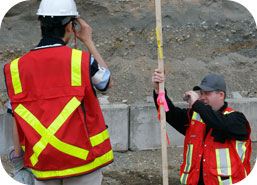
After graduation I joined Al Underhill & Associates Ltd - a seven-person consulting engineering firm in Richmond Hill, ON. It was just like a family. We had one professional engineer making many of the big picture decisions, a couple of very wise and experienced mentors to explain the theory and practice of engineering, a younger designer who took care of all the drafting and technology, and a nice lady who ran the entire office on her own. I was introduced to simple things like how an office works, how construction works, what excavators do, what a watermain, storm and sanitary sewers do. I was taught the basics of hydrology and hydraulics, but not just the academics, how to quantify how much rain will fall, what happens when it hits the ground, and how to design our projects to make sure the water is managed in a safe manner minimizing inconvenience and flooding.
 |
|
|
|
|
|
It was in this first job that I learned what a set of engineering drawings was all about, that they had to convey very precise instructions to the contractor on what to build, where, and to what standard. I learned that engineering, like life, has some hard rules we must abide by, some softer guidelines that we try to achieve, and a whole lot of flexibility to apply our judgement and best knowledge to solve a whole series of problems. I learned how to do these calculations by hand, what factors go into them, how the formulas work, and what reasonable outcomes might be. I got to design a website, prepare a brochure, and a business plan. I found that there were all kinds of interesting assignments I could try if I showed a little initiative. I also learned that most engineers don’t like writing very much, so my ability to write coherent sentences into letters and reports meant I got to prepare all kinds of technical and non-technical reports and submissions.
As will happen to most of you at some point in your career, I felt I was being held back, and that there was a whole world of possibility to explore out there. I felt I was worth more money, that I should tackle larger challenges, I wanted a change. In hindsight, I now see that it’s really very easy to quit and get a new job to solve these problems. I see that sometimes you’re better to stick around and fight for the kind of change you want instead of expecting to find the perfect solution elsewhere. After two-and-a-half great years in my first job, I moved on to another company.
|
|
|
|
|
|
In late 2003, I joined The Municipal Infrastructure Group in Vaughan, ON, which was a start-up company with two experienced engineers that had just left a large multi-national engineering firm to grow their own company. These guys were good! They combined a depth of engineering expertise with strong business acumen. They were networking their clients, they were working their contacts, and they were developing relationships that generated work. I got to see how companies estimate the schedule and cost to complete complex projects. I saw that project management wasn’t just some fluffy course in school but a discipline and area of real interest and value. I learned complex computer modeling and simulation programs. Unfortunately I joined this firm too early in my career – I didn’t have a strong enough background or foundation to perform at this level, and felt I needed a more structured environment to learn the skills that would carry me for the rest of my career.
In early 2004 I joined The Jones Consulting Group in Barrie, ON. This was a multi-disciplinary firm of planners, engineers, and surveyors, numbering maybe 35 people. They had experts in AutoCAD that could teach me how to produce drawings and to expedite my design in ways I’d never seen before. They had guys running river simulations and flooding models. They had engineers designing large subdivisions and communities with innovative water and wastewater treatment solutions. I got to see how City Hall works, how projects get started, approved, and implemented, and the regulatory environment. I spent some time on construction sites, working with the contractor and seeing how things come together. I soaked it all up! I found a way to work with all kinds of different people, learn from them, ask them questions. Offering to help with their work is a great way to get them to show you how they do it!
|
|
|
|
 |
|
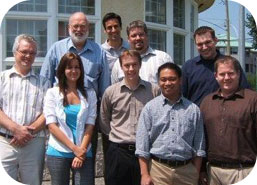
In early 2005 I joined Aplin & Martin Consultants Ltd. in Surrey, BC. Yes, I moved across the country for a job with a 75-person firm that does engineering, planning, and surveying. They made me no promises of where my career might go, rather committed that they would help me achieve my full potential and allow me to grow and develop as quickly as I was able. I did AutoCAD drawings, I did engineering design of subdivisions, townhouses, commercial plazas. I helped develop engineering strategies for entire neighbourhoods. I learned reservoirs and pump stations and wastewater treatment. I learned XP-SWMM simulations, stormwater management, erosion and sediment control.
 |
|
 |
|
|
|
The difference here is that as an employee-owned company, we are all working together for the same goals. I was entrusted with the opportunity to manage projects, bring in clients, start a branch office, then another, to lead and train and develop myself and others. I am given a voice to suggest interesting new opportunities and directions. I am asked to participate in management decisions. I am a trusted and valued member of a team – a team that is stronger than the sum of our parts.
In addition to the work I do on a daily basis, I have attended seminars and training on all kinds of topics from business development to project management to sustainable design. I have gone to conferences in Whistler and Penticton, and was offered the opportunities to go to Ireland and India. I volunteer with my provincial association, Consulting Engineers of British Columbia (CEBC), and work side-by-side with the leaders and visionaries of a dozen other consulting engineering firms in BC. I organize conferences, I guest lecture at universities and occasionally teach a three-day course for a local university. I go to schools to meet and recruit new teammates. I love what I do, every day is different, and it never ceases to amaze me.
 |
|
|
|
|
|
If I had to boil my career, at this point, down to a handful of items I’d attribute my success so far to the following:
- Work hard. Work hard and never stop learning or taking on new challenges
- Take initiative. Even if you don’t understand everything, take the initiative to research and teach yourself something new before being told.
- Get involved. It’s amazing how volunteering results in me meeting clients and building relationships. It also expands your horizons, teaches you new skills.
- Fight for what you want. It’s easy to sit back and wonder why good things happen to other people. It’s easy to blame others for holding you back or not paying you what you’re worth. Acting proactively, addressing the problem, setting up a plan to achieve these goals, these are all steps that allow you to take control of your career and go in the direction you want.